
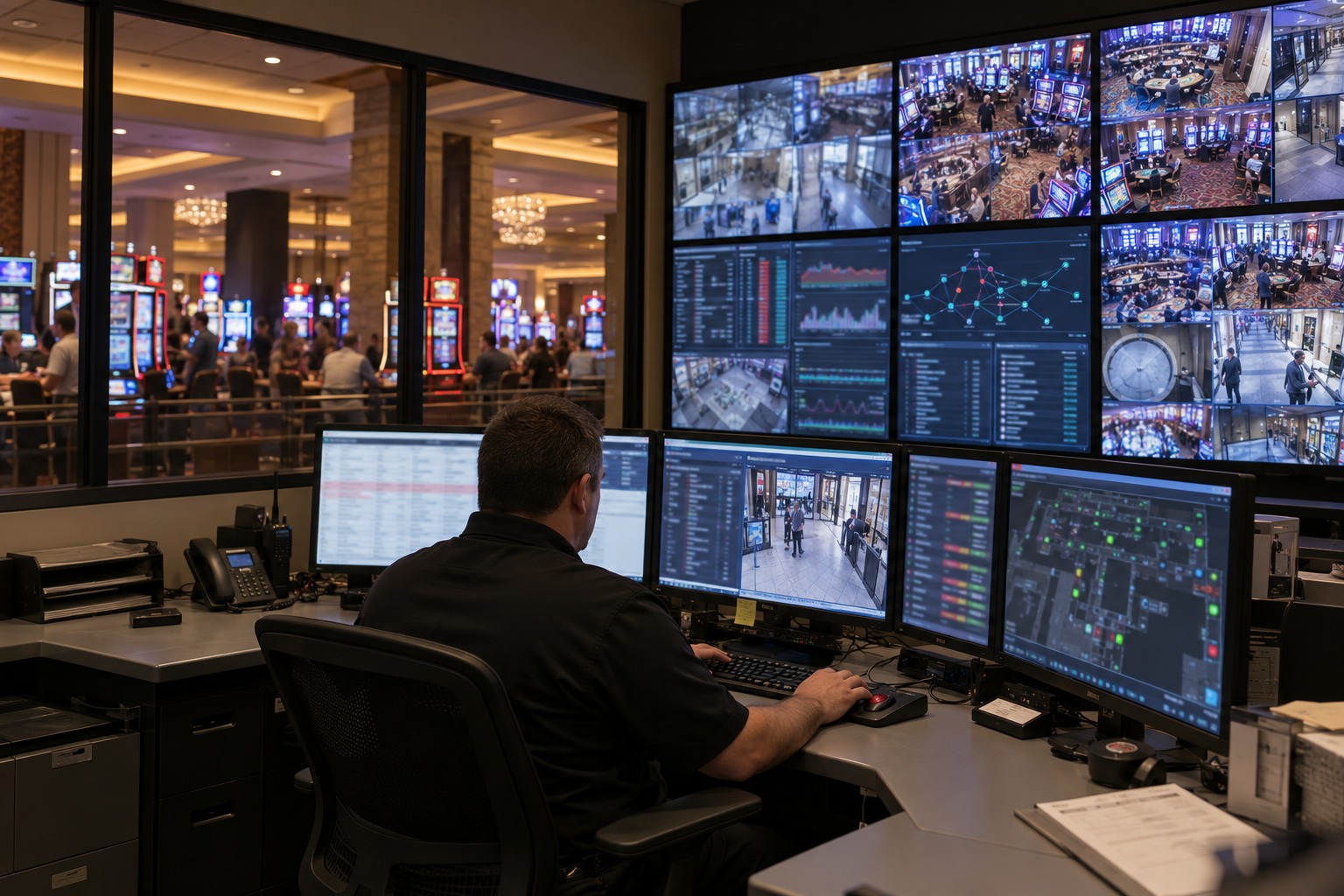
Security works in layers
A casino platform may depend on the public website, account services, payment providers, game suppliers, identity checks and internal administration tools. A weakness in one connected service can affect others, so operators need to map the systems they rely on and decide which data and functions each one can reach. The goal is to prevent common attacks where possible, spot suspicious activity early, and keep a contained problem from spreading.
| Security layer | Common controls | What they are meant to reduce |
|---|---|---|
| Network and website edge | DDoS mitigation, traffic filtering, rate limits and a web application firewall | Service outages and some harmful or automated web requests |
| Application and infrastructure | Secure development, access checks, software updates and independent testing | Abuse of software flaws and known weaknesses |
| Accounts and staff access | Multi-factor authentication, limited permissions and sign-in monitoring | Stolen credentials being used to reach player or administrator accounts |
| Payments and personal data | Data minimisation, protected connections and payment security controls | Unnecessary exposure of identity and card information |
| Monitoring and recovery | Central logs, incident plans and tested backups | Long detection delays, prolonged disruption and avoidable data loss |
Protecting the website from traffic floods
A distributed denial-of-service attack, or DDoS, sends enough traffic or requests to make a service slow or unavailable. It can interrupt logins, account access or a cashier even when the attacker has not entered an account or taken data. New Zealand’s National Cyber Security Centre explains that these attacks can target network capacity, connection resources or the application itself, so a response needs to match the layer under pressure.
Operators commonly arrange DDoS filtering through their hosting, internet or specialist security provider. A content delivery network can serve routine content from distributed locations and absorb some traffic spikes; filtering rules, rate limits and a web application firewall can help screen requests before they reach sensitive services. These controls have limits: a firewall rule can miss a new pattern, block legitimate customers if it is too strict, or fail to stop traffic that overwhelms upstream capacity. Planning with providers before an incident is more useful than trying to find a service during an outage.
The NCSC’s DDoS preparation guidance recommends planning for the relevant type of attack and coordinating with service providers. Its 2025 cyber threat report also notes that defences should be ready in advance. A temporary outage by itself does not prove that customer records were accessed; operators should determine and explain what happened rather than assume the cause.
Building and maintaining safer software
Attackers often look for ordinary software mistakes: a page that trusts data it should check, an account action that does not confirm who is allowed to perform it, or a service left on an old version with a known weakness. Casino operators reduce these risks by defining security requirements before development, reviewing code and settings, testing important journeys, and fixing vulnerabilities according to their severity.

Input validation is one basic part of secure development: an application should check that submitted information is expected and safe to process. It must also enforce permissions on the server, protect session handling, and keep sensitive administration functions separate from ordinary player features. The OWASP Application Security Verification Standard gives teams a structured set of requirements for checking web application security. Using a standard helps make reviews repeatable, but the operator still needs to show which systems were assessed and when.
Updates matter after launch as well. Security fixes for operating systems, libraries, databases and site components should be tracked and applied on a risk-based schedule, with urgent known vulnerabilities addressed promptly. The New Zealand NCSC explains why patching known weaknesses is a core organisational control. Independent penetration testing can add useful evidence, but it is a point-in-time assessment of a defined scope, not a guarantee that every part of a platform is secure forever.
Restricting account and administrator access
Stolen or reused passwords are a common route into online accounts. Casinos can make account takeover harder with multi-factor authentication (MFA), suspicious sign-in detection, alerts about important account changes and protections against repeated automated login attempts. Players should be able to choose a unique password and, where offered, turn on an authenticator or passkey rather than relying on a password alone.
Staff and administrator accounts need stronger controls because they can change settings, view records or manage services. Operators should require MFA for critical access, give staff only the permissions needed for their jobs, remove access when roles change, and use separate, monitored accounts for administration. The NCSC’s guidance on MFA, verification and monitoring highlights these measures alongside centralised logs and alerts for unusual sign-ins.
Logs help security teams notice repeated failed logins, access from unexpected places, unusual account changes or activity outside a normal pattern. Monitoring cannot prevent every misuse, but a timely alert gives an operator a chance to suspend a session, review activity and contact affected customers sooner.
Keeping payment and identity data to a minimum
The safest sensitive data to protect is data an operator does not need to keep. A casino can reduce exposure by collecting only what its service and legal obligations require, limiting who can view identity records, and setting retention periods for data that is no longer needed. Information sent between a browser and a service should use protected connections, while stored sensitive data needs suitable access controls and protection against unauthorised disclosure.
Many websites use a specialist payment provider so the casino does not directly store full card details. That arrangement can reduce the systems holding payment data, but it does not remove the need to check the provider, the integration and the responsibilities in the contract. PCI DSS applies to entities that store, process or transmit payment card data, and to system components that can affect the security of that card-data environment. The PCI Security Standards Council describes the scope in its PCI DSS overview; a logo or generic “PCI compliant” statement is not a public audit of every casino system.
Players can look for a named payment provider and clear privacy information, but should not send passwords, one-time codes or full card security codes to support staff. If a message asks for remote access to a device or an extra payment to “unlock” an account, stop and contact the operator through a known address.
Detecting incidents and restoring service
Even a well-run security programme cannot promise that an attack will never succeed. Operators need a response plan that identifies who can disable affected services, preserve evidence, contact technology and payment partners, and decide what to tell customers. The plan should be rehearsed, since unclear responsibility can add time when teams are dealing with a live incident.
Backups help restore records and services after accidental loss, malicious changes or a disruptive attack, but only if they are protected from the same systems that may be compromised and restoration has been tested. The NCSC’s critical controls summary includes tested backups, application control and security updates. Recovery plans should also cover how to confirm that restored systems are safe before reconnecting them.
After a significant incident, customers need a plain account of what was affected, what information may have been involved, what actions they should take and where to get updates. A generic notice that says “we take security seriously” does not answer whether a player needs to change a password or watch for suspicious transactions.
What a player can check from outside
Most important controls operate behind the website, so a player cannot independently verify a casino’s firewall rules or server configuration. Look instead for practical signs of responsible account handling and transparent communication:
- Optional MFA or a passkey, with clear guidance on protecting and recovering an account.
- Alerts for new sign-ins, password changes and payment or profile changes.
- Privacy terms that name the operator, explain why data is collected and identify relevant payment providers.
- Security or incident notices that describe the issue, dates, affected data and customer actions.
- A support route that does not ask for a password, one-time code, full card security code or remote-control access.
HTTPS protects data in transit between the browser and the site; it does not prove that the company is legitimate, that its internal systems are safe or that it is authorised to operate in New Zealand. A licence, security badge, independent test or compliance claim has a defined scope and date. Verify what each one covers and do not treat it as proof that a site is immune to attacks.
Common questions
Can a casino website be completely protected from hackers-
No. Security controls lower the chance and impact of many attacks, but software, suppliers and threats change. Operators need to keep testing, updating, monitoring and practising incident response.
Does a DDoS attack mean player information was stolen-
Not necessarily. A DDoS attack is intended to disrupt availability. The operator must check separately whether accounts or information were also accessed.
Does a padlock icon prove an online casino is safe-
No. It indicates an encrypted connection to the domain in the address bar. It does not verify the operator, its licence or the security of its internal systems.
What should I do after a casino reports a data incident-
Use the operator’s known website or app to read the notice, change a reused password, enable MFA where available and check account and payment activity. Do not follow unexpected links or share an authentication code with someone claiming to help.